How to calculate your appliances' monthly electricity usage

Direct Energy, November 25, 2025

4 minute read

How to calculate your appliances' monthly electricity usage

Direct Energy, November 25, 2025

4 minute read

Understanding how much electricity your appliances use each month can be an important step toward managing your energy efficiency. Most electric bills show a single kWh usage amount and cost, which lumps together usage from appliances, electronics and your HVAC system, which is typically the highest-use system in your home.

By learning to calculate individual appliance usage, you can identify energy-hungry devices (aside from your AC/furnace) and make more informed choices about when and how you use them. In this guide, we’ll walk you through a simple process to estimate monthly electricity costs for your household devices, no special tools required.

person reviewing their electric bill

Calculate your appliances' monthly electricity usage

You can calculate a decent estimate of how much an appliance or electronic costs to operate each month if you know the wattage, the average amount of time you use it each day, and your current electricity rate.

Most appliances and electronics have a small label that lists the wattage along with other information. Sometimes this information is stamped into metal, like on the base of a light bulb. If you can’t find the wattage on the device itself, you may find it in the user’s manual or on the manufacturer’s website.

  1. To calculate the electricity consumption cost, start by multiplying the wattage of the device by the average number of hours you use it each day. This gives you the watt-hours per day. So, if you have a 120-watt television that you use 4 hours per day: 120 x 4 = 480 watt-hours per day
  2. Next, divide the watt-hours per day by 1,000 to convert it into kilowatt hours per day, or kWh per day: 480 / 1,000 = .48 kWh per day
  3. Since we’re calculating the electricity consumption over a month, you’ll want to multiply the kWh per day by 30: 48 x 30 = 14.4 kWh per month
  4. Finally, multiply the kWh per month by your electric provider’s kWh rate, which you can find on your monthly energy bill. This will give you an estimate of what the device costs to operate per month. So, if you pay 12 cents per kWh: 4.4 x .12 = $1.73 per month

It costs only $1.73 to run this television as usual for a whole month. Repeating this process with frequently used appliances and electronics throughout your home will help you see a clearer picture of where your electricity dollars go.

We have plans for everyone!

Choose from flexible plans that can fit any home, apartment or electricity need.

Understanding energy guide labels for quick comparisons

If you don’t feel like crunching so many numbers, you can also get an idea of how much it costs to operate an appliance by checking its EnergyGuide label.

These distinctive, black-and-yellow labels can be found on most appliances at the point of purchase, as required by the federal government. They break down these same calculations using the national average kWh rate and a standardized measurement of average use.

This provides an easy shorthand for comparing the energy efficiency of appliances in an apples-to-apples way. But it won’t provide results as accurate as your own calculations, which are based on your exact kWh rate and your own usage estimates.

Automate energy tracking with smart home monitoring

If manually calculating electricity usage feels tedious, smart home energy monitors can do the work for you. These devices connect to your electrical panel or plug into outlets to track energy use in real time. Through user-friendly apps, they show which appliances use the most power and when, helping you spot energy hogs and reduce costs.

Smart monitors also offer insights into your consumption patterns, send alerts for unusual spikes, and can integrate with smart thermostats and plugs to automate energy-saving actions. Over time, they help you build better habits and lower your bills without the math.

Here’s a quick look at some popular smart energy monitoring and management options.

Whole-home monitors

Think of this as a bird’s-eye view of your home’s energy use.

  • Installed by a professional right in your breaker panel
  • The paired app shows real-time usage for your entire home
  • Many models can even “learn” which appliances are running and send helpful reports and alerts1
     

Circuit-level monitors

Want a bit more detail without going full DIY expert?

  • Some options you can install yourself (though an electrician can help)
  • Tracks individual circuits separately so you can see exactly where your power is going
  • Great for spotting heavy-use areas or monitoring solar production if you have panels2
     

Smart power strips/ plugs with energy monitoring

The easiest place to start.

  • Just plug them into the wall, connect to Wi-Fi and you’re set
  • Shows you how much energy a single device is using in real time
  • Lets you switch things on/off from your phone or set schedules to avoid wasted energy
     

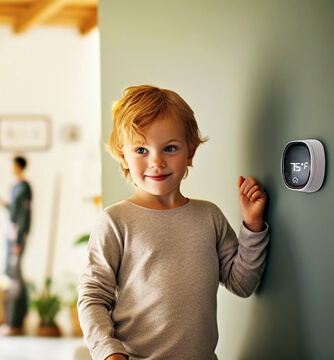
Smart thermostats

A small upgrade that makes a big difference.

  • DIY-friendly (or get a pro to install it) and controlled right from your phone or smart speaker
  • Automatically adjusts heating and cooling to save energy
  • Some offer monthly HVAC energy reports and learn your routine over time

  • Plays nicely with other smart devices for a more connected, efficient home


Energy saving tips for major appliances

Every appliance in your home plays a role in your overall energy consumption, but some use far more electricity than others. Understanding how to save energy for each major appliance type can help you cut costs without sacrificing comfort. Along with choosing  the ENERGY STAR-certified appliances and electronics, a few simple tips can go a long way toward savings.

Check out these quick tips, or click-through each to learn more about each appliance’s energy consumption.

Water heater

  • Set the thermostat to about 120° F instead of the default 140° F
  • Don't linger too long in the shower
  • Install low-flow faucets and shower heads
  • Insulate your tank with an inexpensive insulation blanket
  • More about water heater energy consumption
     

Refrigerator

  • Don't overload your refrigerator
  • Keep most-used foods in accessible areas
  • Set your fridge to the manufacturer's recommended temperature
  • Regularly clean behind and underneath the refrigerator to maintain airflow
  • More about refrigerator energy consumption
     

Oven and stove

  • Use a toaster oven, microwave, slow cooker or other smaller appliance instead
  • Use the oven and stove during cooler hours of the day
  • Don't preheat unless it's necessary for the dish to cook properly
  • Turn off the burners a few minutes before dish is done and let residual heat do the rest
  • More about oven and stove energy consumption  


Dishwasher

Washer and dryer

Electronics

  • Deactivate standby mode and quick-start settings
  • Turn down screen brightness on televisions and monitors
  • Always turn off (or unplug, when applicable) electronics when they're not in use
  • Choose more energy-free entertainment activities like reading and board games
  • More about electronics energy consumption
        

Simple steps for more efficiency

Whether you calculate appliance costs manually, check Energy Guide labels, or invest in smart monitoring tools, tracking your appliances’ electricity usage can help you make informed decisions and reduce waste. Combine these insights with simple energy-saving habits, and you’ll be well on your way to better-managing your monthly energy bills while living more efficiently.


Sources

1Sense.com: How the Sense Energy Monitor Works  

2Emporia.com: Vue Home Energy Monitor


Explore the learning center

Explore our other categories by selecting one from the dropdown menu. 

1982472_DE Category Page Large Promos_FinalImagesforDev

Download the app

Get the Direct Energy app to easily manage your account, keep an eye on your usage, refer friends and more.


Signing up for Direct Energy is easy!

We offer a wide range of plans and even help you customize them to fit your needs! Shop our plans to find your best fit today.  

Need help placing an order?
Texas customers: Call us at 1-855-461-1926
Northeast and Midwest customers: Contact us


Questions about your current service?
Texas customers: Call us at 1-888-305-3828
Northeast and Midwest customers: Contact us